


17 August 2026
The Low Carbon Hydrogen Agreement, the Hydrogen Allocation Rounds (HAR1 and HAR2), and the government's ambition for 10GW of low-carbon hydrogen capacity by 2030 were all designed to give developers the confidence to build.
Since those implementations, significant progress has been made in laying the foundations for a UK hydrogen economy, yet 2025/26 has told a more complicated story.
Reasons for delay
BP walked away from its 1.2GW H2Teesside project. SSE Thermal paused three hydrogen production projects, including the 1GW H2NorthEast CCS-based project in Teesside. Across the sector, developers have pointed to slow-moving policy and unresolved contract negotiations as key reasons for delays.
HAR2's shortlist of 27 projects, totalling 765MW, was announced in April 2025. More than a year later, the shortlisted projects are still awaiting the start of the 'Invite to Offer' stage, with government now aiming to award contracts during 2026, and the promised updated Hydrogen Strategy has yet to appear. The Hydrogen Energy Association and other industry bodies have warned that continued delays risk threaten jobs and private investment.
But policy uncertainty may only explain part of the picture. Looking more closely at why several projects have stalled another theme emerges alongside regulatory delay -demand has not developed as quickly as supply. BP's decision on H2Teeside was partly influenced not only by planning issues but by the loss of a nearby industrial hydrogen customer. Norway's Aukra blue hydrogen project faced a similar challenge with Shell specifically citing a lack of demand as a reason to put the project on hold. Globally, BloombergNEF estimates that only around 10% of announced clean hydrogen production capacity expected by 2030 has secured committed buyers.
If that figure is broadly representative, it suggests the UK's hydrogen challenge is evolving. The next phase is no longer simply about producing low-carbon hydrogen, but about creating the market conditions that encourage organisations to use it.
Challenges remain, but the future looks promising
This challenge is familiar to anyone involved in developing new energy infrastructure. Hydrogen production projects require long-term offtake agreements before investors will commit capital. Industrial customers, meanwhile, want confidence that reliable supply, infrastructure, and competitive pricing will exist before signing contracts.
The Oxford Institute for Energy Studies describes offtake agreements as one of the critical mechanisms for unlocking investment because they provide certainty to both producers and financiers. Similarly, the International Energy Agency identifies uncertain demand and the lack of firm offtake agreements as among the principal barriers to scaling the global low-emissions hydrogen economy.
The encouraging news is that the demand picture is starting to become clearer as hydrogen is increasingly finding its role in sectors where electrification alone is unlikely to deliver net zero.
Heavy industry is perhaps the clearest example. While electrification will rightly do much of the heavy lifting across the economy, some industrial processes require high-temperature heat or feedstocks that electricity cannot easily provide. Steel, chemicals, fertilisers, refineries, cement, ceramics and glass all represent sectors where green and blue hydrogen are viewed as practical decarbonisation pathways.
The Climate Change Committee's latest progress report reinforces this point. While calling for faster electrification across the economy, it also acknowledges that credible plans for industrial decarbonisation remain incomplete and that government must provide much greater clarity on commercially viable pathways for industry.
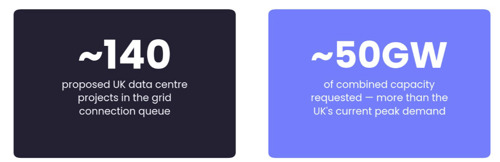
Another emerging source of demand is starting to emerge from data centre operators. The rapid growth of artificial intelligence is driving unprecedented demand for computing power and electricity. Across Europe, developers are increasingly encountering grid connection delays, prompting operators to explore hybrid energy systems that combine renewable electricity with flexible generation, battery storage and, over time, low-carbon gases.
Operators are also looking for fuel-flexible assets capable of operating initially on natural gas or biomethane before transitioning to hydrogen blends and eventually 100% hydrogen as supply matures. Hydrogen fuel cells, hydrogen-ready gas engines and co-located hydrogen production are all moving from concept towards demonstration.
While data centres are unlikely to become hydrogen's largest customer overnight, they could become an important anchor market, particularly because reliability is just as important as decarbonisation for mission-critical digital infrastructure.
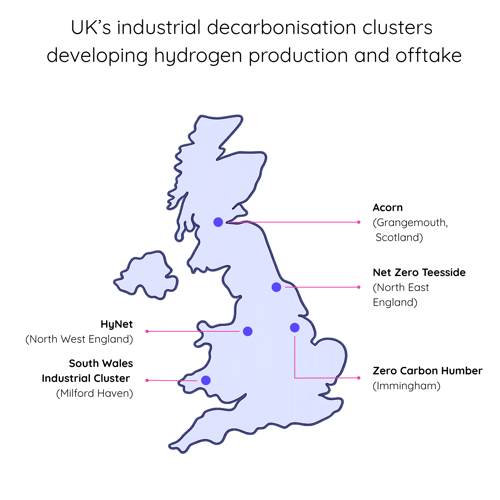
The UK's emerging industrial clusters also offer reasons for optimism. Projects around Teesside, the Humber and HyNet are not simply producing hydrogen, they are creating regional ecosystems where production, transport, storage and multiple industrial users develop together. Aggregating demand in this way reduces risk for individual businesses while improving the economics of shared infrastructure.
Building demand, not just supply
Recognising this shift, governments are starting to look beyond production subsidies towards mechanisms that actively stimulate demand – a shift the UK could learn from.
Germany's H2Global programme is one of the best-known examples. Rather than leaving producers and buyers to negotiate directly in an immature market, the scheme uses an intermediary to bridge the gap between the cost of producing renewable hydrogen and the price industrial customers are willing to pay. Producers benefit from long-term purchase agreements that provide investment certainty, while buyers can access hydrogen through shorter-term contracts, reducing the commercial risk of committing to a rapidly evolving market.
At the same time, developers themselves are adapting. Instead of building speculative, large-scale production facilities in anticipation of future demand, many are pursuing phased projects anchored around committed industrial customers from day one.
The next chapter for hydrogen
Hydrogen's role in a decarbonised energy system has always extended beyond simply replacing natural gas. While its greatest value does lie in decarbonising the parts of the economy that are hardest to electrify, providing flexibility and resilience within an increasingly renewable energy system is becoming just as important.
The UK has already laid many of the foundations needed to support low-carbon hydrogen production. The next challenge is ensuring that demand develops alongside it.
Encouragingly, that demand story is beginning to take shape. Hard-to-abate industries are identifying where hydrogen offers the greatest decarbonisation value. Data centres are emerging as a promising new demand source, needing the kind of flexible, resilient power that hydrogen could help provide, while industrial clusters are bringing producers and users together in ways that improve the economics of shared infrastructure.
At the same time, policymakers are increasingly recognising that market creation requires more than production incentives alone.
Turning these opportunities into a functioning market will depend on more than funding individual projects. It requires coordinated infrastructure, clear regulation, robust market frameworks and, crucially, trusted data that gives investors, network operators, industrial users and policymakers the confidence to make long-term decisions. Visibility of future demand, infrastructure availability and network utilisation will be just as important as the physical assets themselves in ensuring production, transport, and consumption develop alongside each other.
The future of hydrogen will therefore be defined not simply by how much we produce, but by how effectively we connect production with the organisations ready to use it. For organisations like Xoserve, helping to build that confidence through trusted market data and enabling the systems that underpin a decarbonised gas network will be just as important as the molecules themselves.
Get in touch
Learn more about hydrogen and the role it can play in decarbonising the gas grid on our dedicated hydrogen pillar page.
If you have any feedback or questions on any of the above, please email us at decarbonisation@xoserve.com.
Share this news article