


Project Girvan
Girvan is an innovative biomethane injection project on the SGN network, designed to reduce carbon emissions and operational costs by removing routine propane enrichment of biomethane.
Located in Girvan, Ayrshire on the west coast of Scotland, this project focuses on delivering a long-term affordable decarbonisation solution for the edges of the gas network by enabling the injection of non-propanated, locally produced biomethane into the gas grid to power industrial and commercial sites.
Project Girvan has been live since 27 October 2025.
Three key stages of the project
- Biomethane production – Using byproducts from a local distillery, Grissan Renewable Energy’s nearby green gas facility can produce enough gas to heat 50,000 homes each year.
- Non-propanated biomethane injection – Traditionally, biomethane is mixed with propane to increase its energy content and ensure it meets the LDZ average daily CV required for transportation within the UK gas grid. This is an expensive process and reduces the carbon emissions savings that would otherwise be achieved using ‘pure’ biomethane. As part of its Net Zero ambitions, SGN has implemented a solution that uses chromatographs, monitoring and control technologies to inject non-propanated biomethane into nearby industrial sites.
- Analysis and extrapolation – With the implemented solution, Project Girvan provides a proven template demonstrating how non-propanated biomethane can support affordable decarbonisation within the GB gas network.
Xoserve's service role
Xoserve plays a central settlement and data assurance service role in Project Girvan, ensuring that biomethane supplied without propane can be accurately measured, allocated and billed within existing industry frameworks.
February 2023 – The implemented CDSP solution applies the site-specific CVs provided by SGN for the participating Class 1 and 2 Supply Meter Points and uses the value in energy calculation instead of Flow Weighted Average Calorific Value (FWACV).
October 2025 – Project Girvan went live, enabling three industrial sites to receive biomethane without routine propane enrichment.
October/November 2025 – First usage and post-implementation support was delivered through the review and ongoing monitoring of the implanted solution, with final assurance provided by SGN, confirming the successful implementation of the solution.
How Project Girvan will work
Because the project applies site-specific calorific values rather than a standard FWACV, precise measurement is critical to ensure for billing, regulatory compliance and confidence in the energy delivered.
Enhanced gas quality measurement enabled by three dedicated chromatographs, measure:
- Biomethane without propane
- Biomethane with propane
- Gas delivered to the three impacted SMPs
This allows precise tracking of both volume and CV at each stage, ensuring the energy delivered matches the energy calculated.
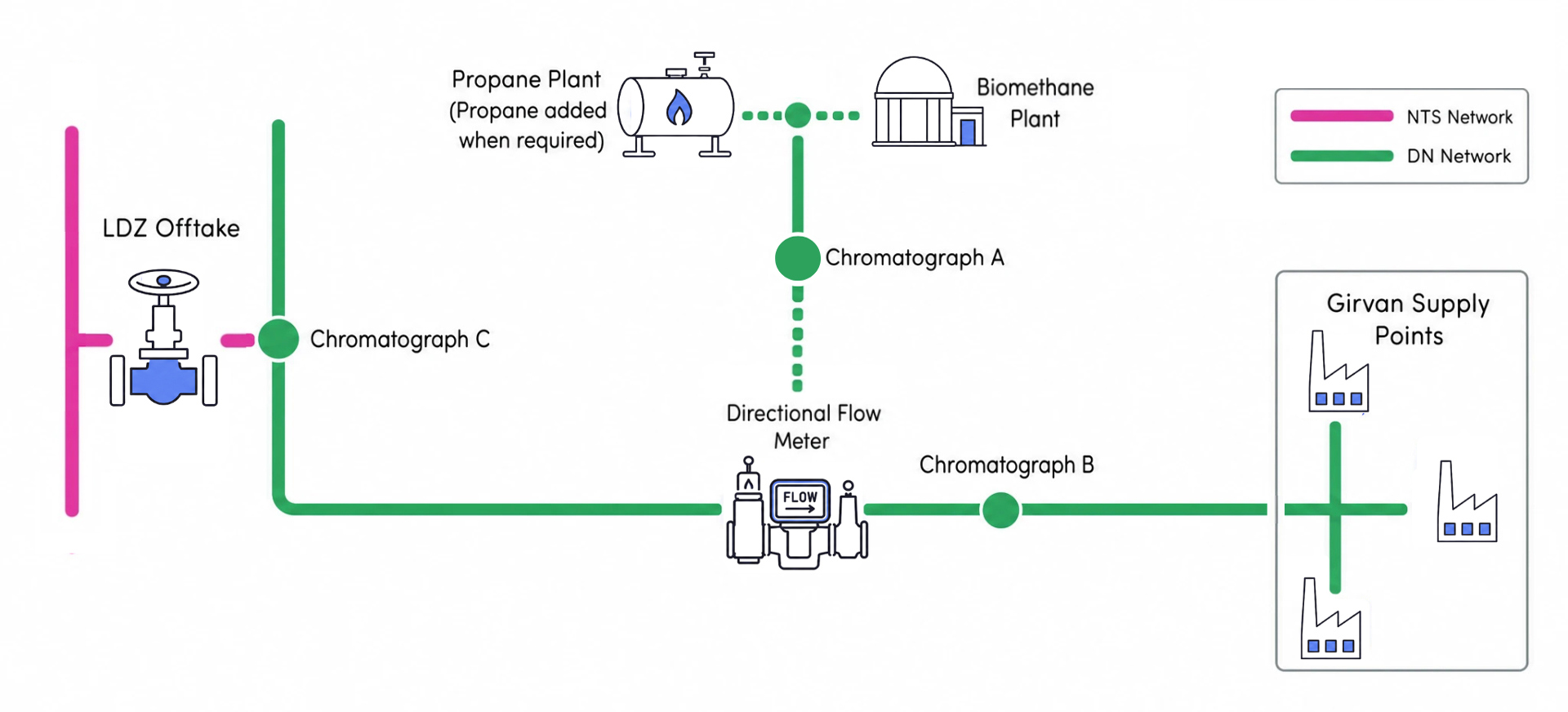
Diagram illustrating how Project Girvan will operate.
Site-specific CV billing
A solution delivered by Xoserve enables the three participating SMPs to be billed using their actual measured CV rather than the FWACV applied across the wider network.
By aligning settlements with the measured energy content, this approach ensures that billing accurately reflects actual consumption. Due to existing allocation and reconciliation rules, the solution currently applies to Class 1 and 2 SMPs only. However, it establishes a framework that could be extended to other qualifying biomethane sites in the future.
If there is an excess of biomethane that the three sites cannot utilize the surplus is propanated and fed into the LDZ ensuring all downstream customers receive CV appropriate gas and are billed correctly for their energy use.
Project Girvan’s role in decarbonising Britain’s gas industry
Project Girvan demonstrates how renewable gas can be produced locally and safely injected into the network, to supply lower emission power for businesses.
By removing the need for propane enrichment, the solution delivers carbon emission reductions and makes biomethane more affordable, making it viable for a much wider range of communities across the UK.
Together, these enhancements greatly strengthen the role that renewable biogases can contribute to Britain’s pathway to Net Zero.
Beyond the immediate emissions reduction, the project provides valuable evidence on how calorific value management, settlement processes and network controls can adapt to support lower-carbon gas flows. The learning generated at Girvan will help inform future policy, regulatory development, and operational standards, particularly as biomethane volume continues to grow.
If scalable, this approach could reduce reliance on fossil-based enrichment gases more widely and affordably enable far greater reductions in the UK’s overall carbon emissions.
Potential impacts on the gas industry following Project Girvan
- Greener source of energy that reduces greenhouse gas emissions.
- Lower operational costs due to reduced or no requirement for propane.
- Improved energy security through increased energy independence.
- Support for renewable energy production through continued innovation in the sector.
Get in touch
If you want to know more about the project, please email us at decarbonisation@xoserve.com.
Related links
Subscribe to DeliveringDecarb
Be the first to read the latest edition of our monthly newsletter, which highlights the latest news and updates in the gas decarbonisation space.